
Computer Sciences [NAT]
Section outline
-
-

Dear Learner,
A very warm welcome to the course. We are delighted to have you join this course for your National Apptitute Test (NAT) preparation. This course has been designed to guide you step-by-step through the core components of NAT-ICS, while keeping the experience interactive and supportive.
Course Structure
The course is divided into 6 units and 10 lessons, supported by 400+ quiz questions to help you practice thoroughly. Each unit has a time restriction — lessons will only be available according to the schedule mentioned in the course plan. Please make sure to follow the timeline so you do not miss any content.
Here’s what the course will cover:
Unit A - Verbal Reasoning - Building your vocabulary, comprehension, and critical reading skills.
- Lesson 1: Sentence Completion
- Lesson 2: Analogy
- Lesson 3: Acronym
- Lesson 4: Synonyms
- Lesson 5: Comprehension
Analytical Reasoning - Practicing puzzles, logical patterns, and reasoning questions.
- Lesson 1: Analytical Reasoning
Quantitative Reasoning - Strengthening your problem-solving and numerical analysis skills.
- Lesson 1: Word Problem
- Lesson 2: Algebra
- Lesson 3: Geometry
Physics – Reviewing core concepts and solving application-based problems.Mathematics – Covering algebra, geometry, and advanced problem sets relevant to NAT.Computer Sciences – Revising key computer science fundamentals and problem-solving strategies.The total duration of the course is 8 days starting from October 12, 2026.
Assessments
- Each unit contains quizzes and practice activities.
- You will attempt around 400 quiz questions, designed to mirror the NAT-ICS test style.
- Continuous assessments will track your progress and help you identify areas for improvement.
So focus on the announcements of the course to keep on track.
Online Sessions
This blended course is complemented with 5 live online sessions on Zoom with your instructor. These sessions are an opportunity to:
- Ask questions directly.
- Engage in live discussions.
- Get clarity on difficult topics.
Please keep an eye on your calendar regularly for the schedule of these Zoom sessions.
What guarantees you to be success in NAT-ICS test
Your commitment and active participation are key to making the most of this course. Stay on track with the lessons, complete the quizzes on time, and actively join the online sessions. We are here to support you at every step!
We wish you a productive and successful learning journey. Let’s get started!
-
-
-
Opened: Saturday, 19 September 2026, 5:00 PMDue: Sunday, 20 September 2026, 5:00 PM
-
-
The word "quantitative" has been derived from quantity and we know that qualities are generally described in numbers. Quantitative Reasoning is the ability to use numerical and mathematical skills to analyse and interpret data, solve problems, and make decisions based on quantitative information.
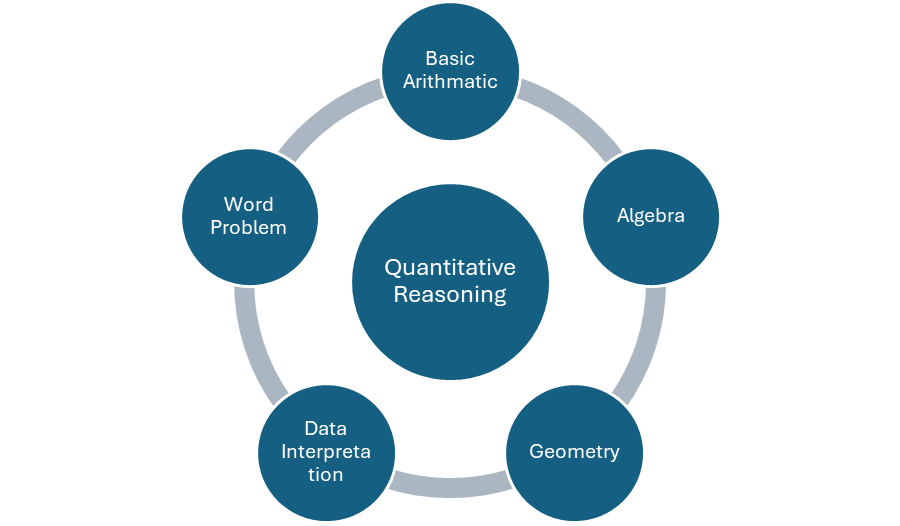
Quantitative reasoning is used in many areas of mathematics, including basic arithmetic, algebra, geometry, data science, and word problems.
In the coming short lessons, you will learn how quantitative reasoning applies to each of these subjects, one at a time.
To begin, click on the first lesson, “Word Problems,” in the left-hand side panel.
-

Find us at
- Location : Office 302, Rawat Technology Park, Rawat, Islamabad
- Phone : +92 345 8507802
- Email : contact@bridgetouniveristy.com
© B2U All Rights Reserved by Global Gradsway.